From July 2 to July 6, 2026, students of the Tsinghua University PBC School of Finance Belt and Road Initiative EMBA (BRI EMBA) completed an immersive overseas module in Astana, Kazakhstan. Centered on the theme of Central Asia’s development under the Belt and Road Initiative (BRI), the module brought together senior government officials, leaders of Kazakhstan’s sovereign wealth fund, and executives from the region’s leading artificial intelligence and innovation institutions. Through a combination of keynote policy addresses, corporate and institutional visits, rigorous academic instruction, and case-based discussions, students gained a comprehensive understanding of Central Asia’s evolving business landscape while strengthening high-level dialogue between Chinese and Kazakh government, business, and academic communities.
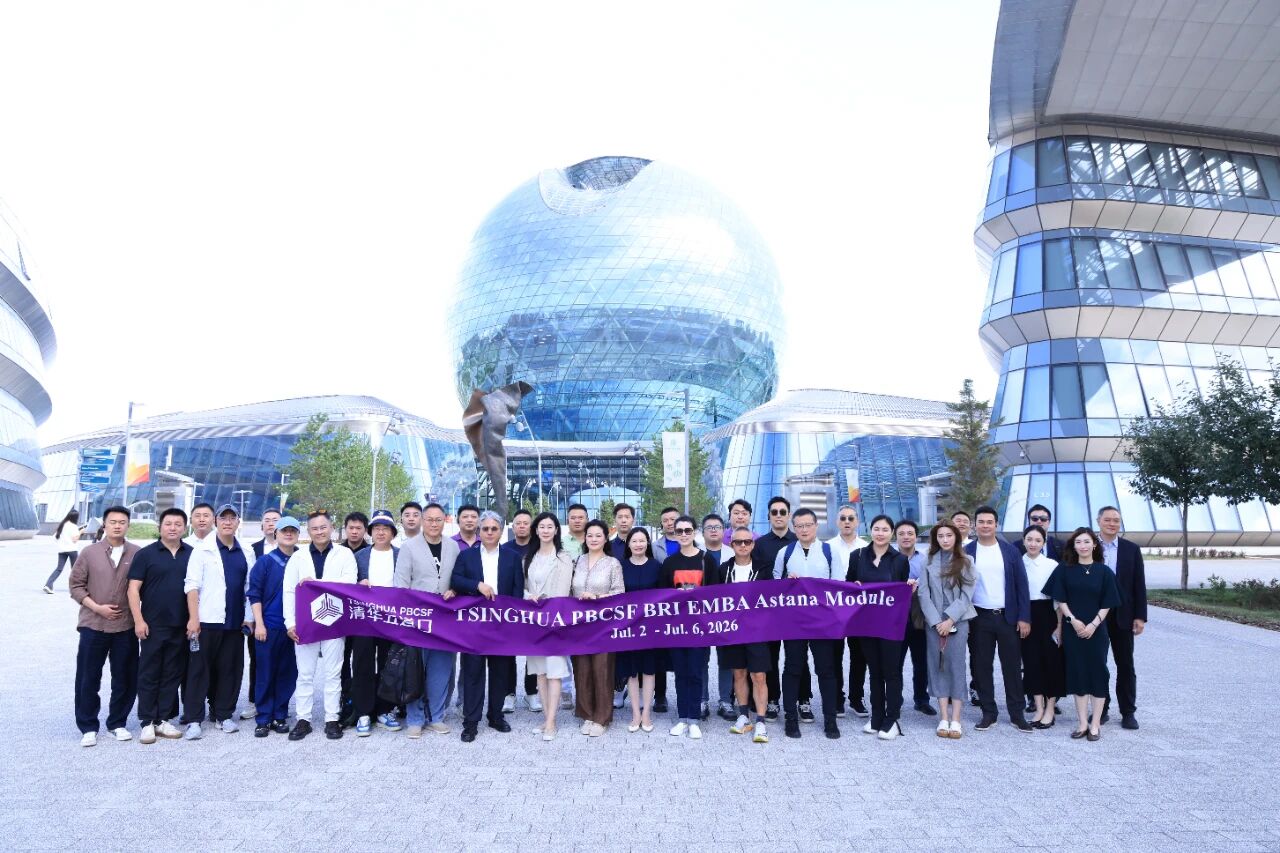
Photo: Group photo of the BRI EMBA Astana Module
Distinguished Government and Business Leaders Share Insights at the Birthplace of the Silk Road Economic Belt
The academic component of the module was hosted by Nazarbayev University, where an exceptional lineup of senior policymakers and industry leaders delivered lectures and engaged directly with students.
His Excellency Sayasat Nurbek, Minister of Science and Higher Education of the Republic of Kazakhstan, delivered a keynote address titled “Belt and Road & New Opportunities in Central Asia.” His presentation focused on Kazakhstan’s higher education and artificial intelligence development strategy.
Minister Nurbek outlined Kazakhstan’s efforts to establish itself as a regional education hub through international academic collaboration, expanded university partnerships, and the introduction of world-class educational resources. Against the backdrop of the Belt and Road Initiative, he shared Kazakhstan’s strategic vision for advancing education, scientific research, talent development, and regional cooperation.
The Minister also emphasized the transformative impact of artificial intelligence on higher education and national competitiveness. He explained Kazakhstan’s ongoing efforts to integrate AI into the education system, build AI capabilities among students, faculty, and researchers, and explore AI-enabled universities, personalized learning, intelligent agents, data governance, and industrial applications. He further highlighted Kazakhstan’s commitment to preserving national and minority languages in the digital era through the development of large language models for Kazakh and other regional languages.
His remarks prompted lively discussions among students on education reform in the AI era, talent cultivation, data governance, and enterprise AI applications.
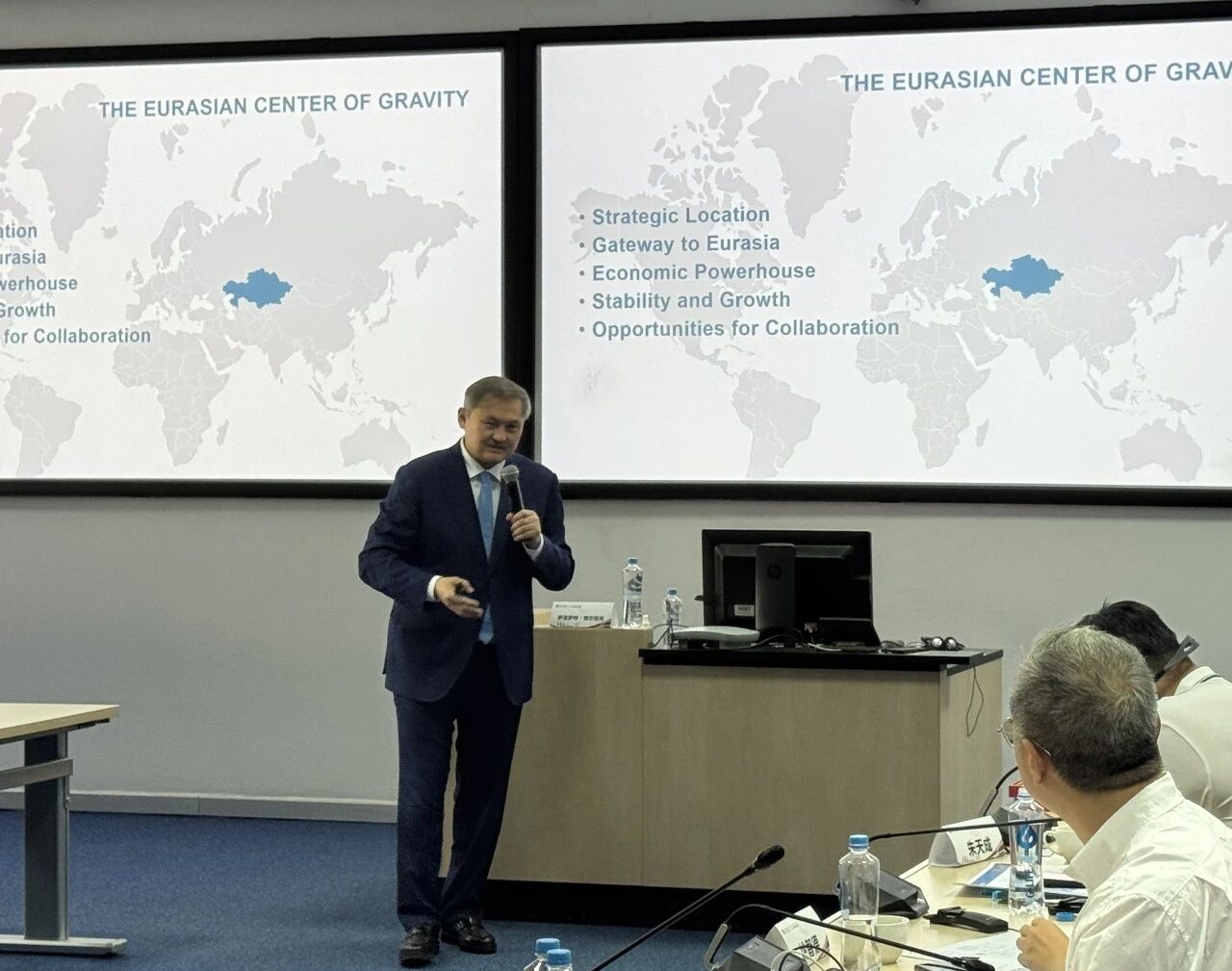
Photo: H.E. Sayasat Nurbek
Saken Pirmakhanov, Chief Executive Officer of Samruk-Kazyna Invest, the investment arm of Kazakhstan’s sovereign wealth fund, delivered a keynote presentation entitled “Samruk-Kazyna: Driving Kazakhstan’s Economic Development.”
He introduced the strategic role of the Samruk-Kazyna Group in Kazakhstan’s economic development, industrial investment, infrastructure construction, and international cooperation. Drawing on the Group’s diversified portfolio spanning oil and gas, transportation, telecommunications, mining, energy, and chemicals, he explained how Samruk-Kazyna leverages capital allocation, industrial project development, strategic partnerships, and localized manufacturing to serve as both a catalyst for foreign direct investment and a national platform for industrial development.
During the interactive session, Mr. Pirmakhanov engaged students in discussions on practical cross-border investment projects, exploring pathways for Chinese investment into Kazakhstan, Kazakh enterprises’ expansion into China, and bilateral industrial collaboration.
Joining the discussion was Lazzat Borankulova, Representative of the Astana Hub Shanghai Innovation Center and Founder & CEO of Growth Vision Pro, who exchanged views with students on project implementation, innovation ecosystem development, cross-border resource integration, and emerging business opportunities.
The session enabled students to develop a deeper understanding of Kazakhstan’s sovereign investment platform while gaining firsthand insights into the significant opportunities for China-Kazakhstan cooperation in energy, infrastructure, industrial investment, innovation, and bilateral market expansion under the Belt and Road framework.
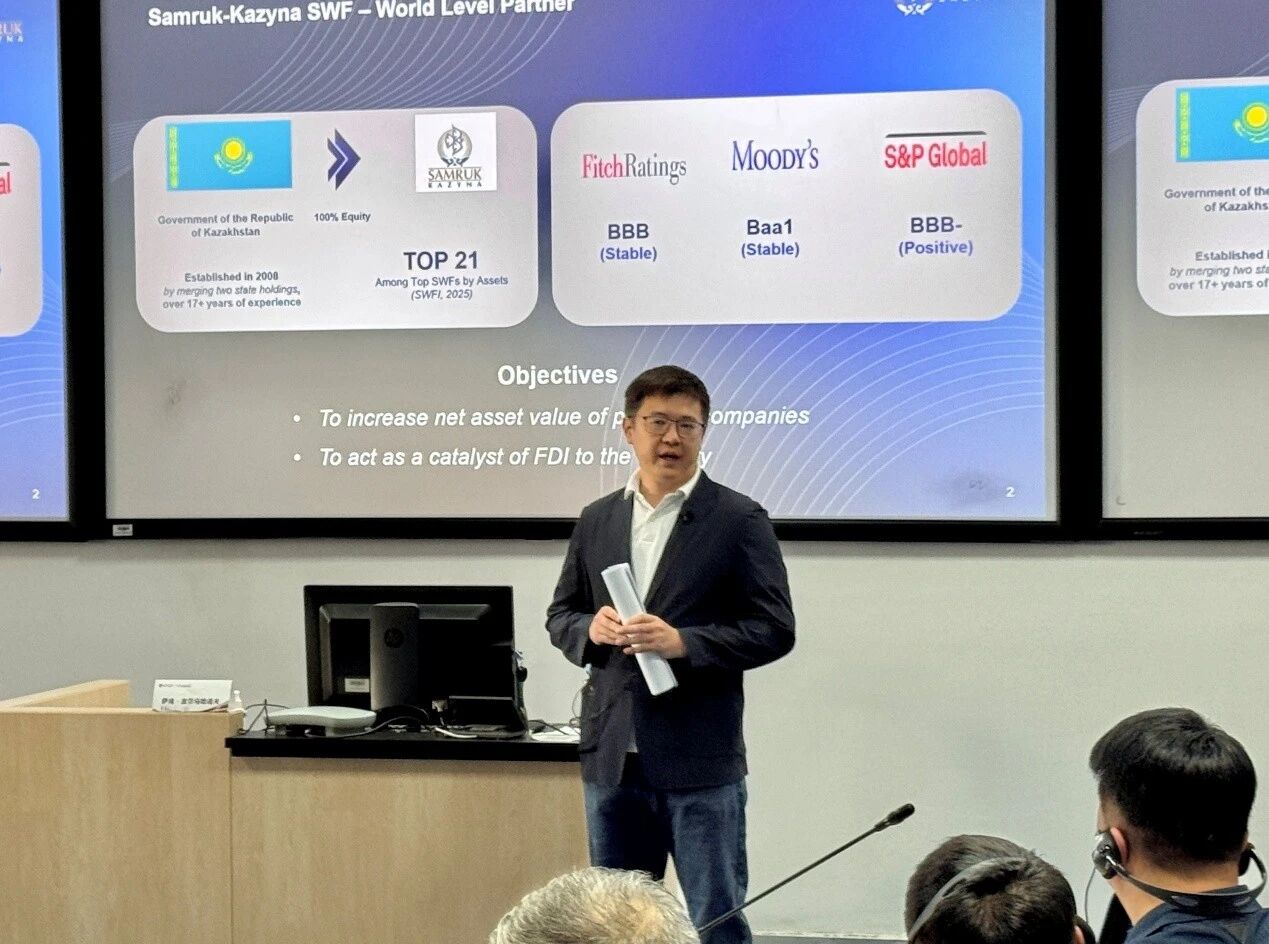
Photo: Saken Pirmakhanov
Nazarbayev University attached great importance to the module. Kadisha Dairova, Vice President, and Professor Joep Konings, Dean of the Graduate School of Business, warmly welcomed the delegation.
Students also visited the University’s historic Senate Hall, a venue of profound historical significance. It was here, on September 7, 2013, that President Xi Jinping delivered his landmark speech introducing the vision of jointly building the Silk Road Economic Belt, marking the birthplace of what would become the Belt and Road Initiative.
As the 10th anniversary of the Tsinghua PBCSF BRI EMBA approaches, students visited Senate Hall to revisit the origins of the Initiative and reflect on its enduring vision. Returning to the birthplace of the Belt and Road carried both symbolic and historical significance, making this Astana module a memorable milestone in the Program’s decade-long journey.
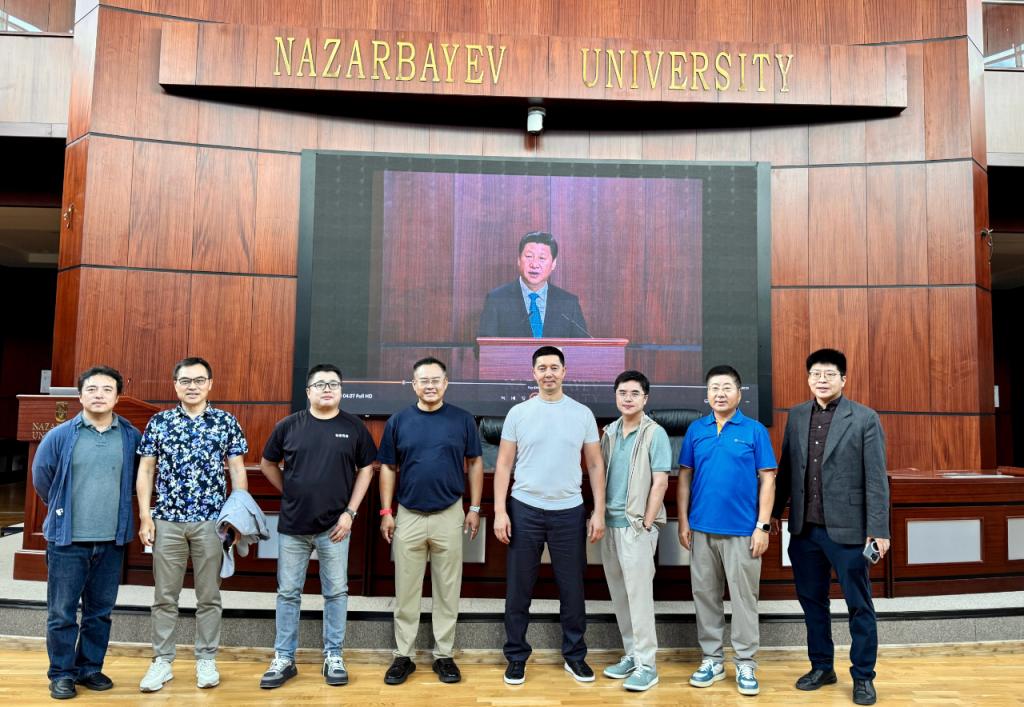
Photo: BRI EMBA students visiting Senate Hall
During the academic sessions, Professor Anjan Ghosh of the Nazarbayev University Graduate School of Business (NUGSB) taught “Understanding the Business Culture in Kazakhstan.”
The course examined Kazakhstan’s business environment, cultural practices, communication styles, and market dynamics. Beginning with the relationship between culture and business cooperation, Professor Ghosh traced Kazakhstan’s cultural transformation since independence and analyzed how its historical evolution has shaped today’s business practices, organizational behavior, and commercial institutions.
Through case discussions, he emphasized that successful China-Kazakhstan business cooperation requires moving beyond a single-market perspective. While Chinese enterprises should draw upon their own experience, they must also develop a nuanced understanding of Kazakhstan’s local cultural context.
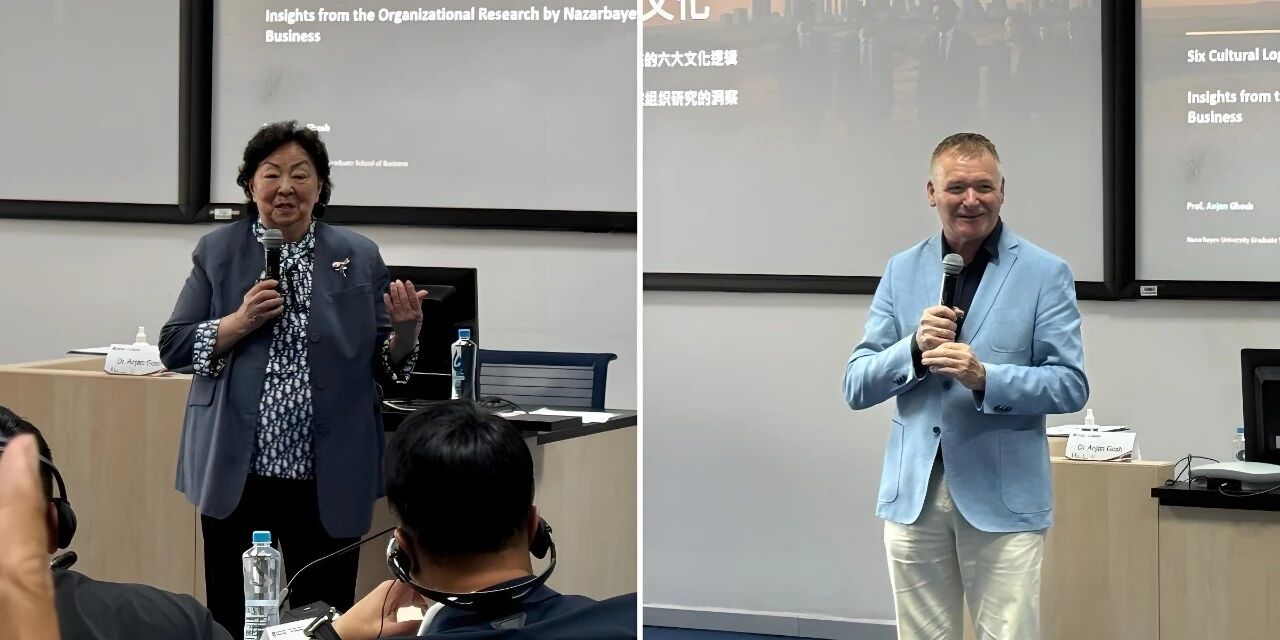
Photo: Kadisha Dairova (left), Joep Konings (right)
Immersive Industry Visits Offer a Panoramic View of Central Asia’s Innovation Ecosystem
To complement classroom learning, students undertook a series of institutional visits focused on Central Asia’s financial opening, technological innovation, and industrial transformation. The delegation visited the Astana International Financial Centre (AIFC), Alem AI International Artificial Intelligence Center, and Astana Hub, gaining firsthand insights into Kazakhstan’s financial system, AI ecosystem, startup incubation framework, and investment-friendly business environment.
At the AIFC, students first toured the Financial Museum, where historical artifacts—including Silk Road trade relics, railway bonds, early petroleum securities, and historical currencies—illustrated Kazakhstan’s financial development from the Silk Road era to the present day.
Students learned about Kazakhstan’s dual-exchange structure: the domestic exchange operates under Kazakhstan’s civil law system, while the AIFC Exchange adopts English common law and maintains close cooperation with the Hong Kong Stock Exchange.
AIFC officials subsequently introduced Kazakhstan’s resilient macroeconomic fundamentals, youthful talent base, and ongoing economic transformation toward industrial diversification, green finance, and digital innovation.
As Central Asia’s leading international financial center, the AIFC has established a comprehensive international financial ecosystem. It now hosts more than 5,900 registered companies, has attracted over US$25 billion in investment, and offers an independent judicial system, international arbitration mechanisms, globally aligned regulation, favorable tax policies, and one-stop services for international professionals.
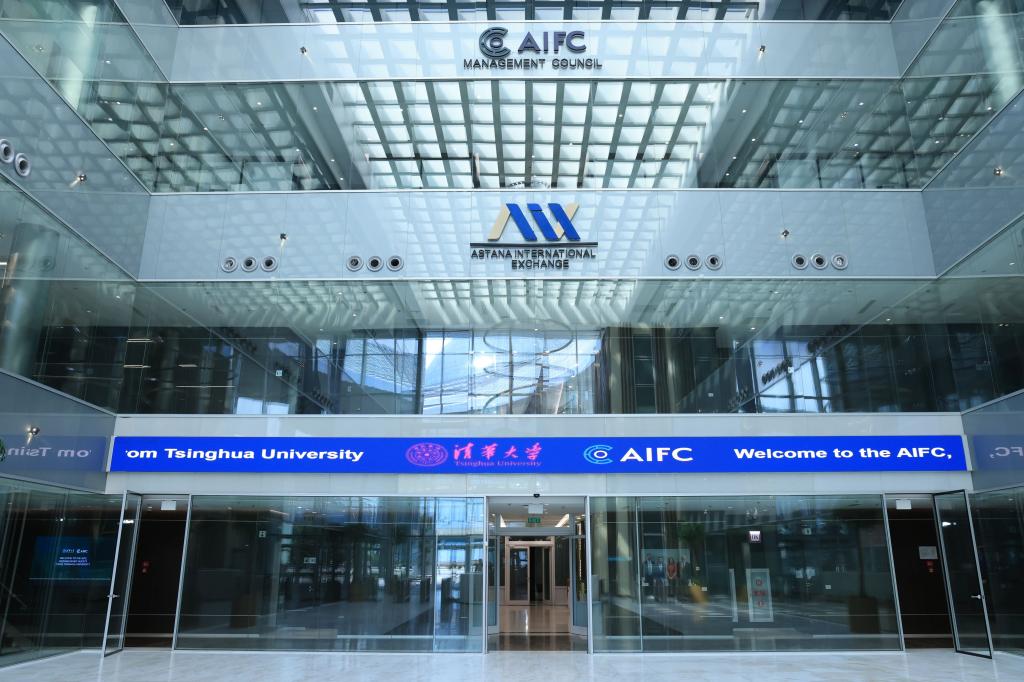
Photo: Visit to the AIFC
The delegation then visited Alem AI, Kazakhstan’s national flagship platform for artificial intelligence innovation.
Located within the iconic Astana Expo complex, Alem AI integrates AI education, frontier technology research, startup incubation, and talent development, serving as one of Central Asia’s largest AI innovation ecosystems and a cornerstone of Kazakhstan’s digital economy strategy.
Students explored four themed exhibition areas. The history gallery traced the evolution of computing technologies since the seventeenth century. The AI Cinema showcased original AI-generated films. The technology hall demonstrated advances in natural language processing, computer vision, machine learning, and quantum computing. The smart city exhibition illustrated AI applications across healthcare, finance, environmental protection, astronomy, and intelligent transportation.
Students also learned that one local medical AI company has trained diagnostic models using more than 200,000 real clinical cases, achieving diagnostic accuracy exceeding 90 percent. Another domestic mobile game developer generates US$47 million in annual revenue through highly interactive multiplayer games popular across Europe and is preparing to enter the Chinese market.
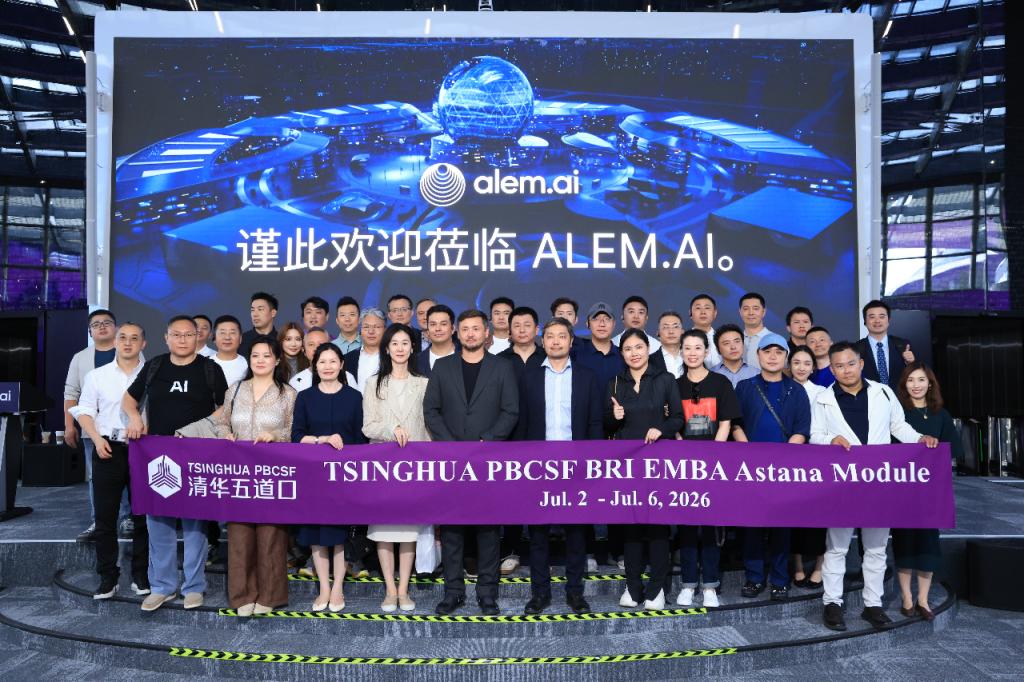
Photo: BRI EMBA students at Alem AI
The final industry visit brought students to Astana Hub, Central Asia’s leading technology and startup ecosystem.
Astana Hub currently hosts more than 2,200 registered technology companies generating approximately US$2 billion in annual revenue. Supported by a nationwide network of 20 regional offices, national digital economy initiatives, and AI talent development programs, the Hub has become a major driver of Kazakhstan’s innovation ecosystem.
Its incubation platform is complemented by robust investment support. Together with Google, Astana Hub operates the Silkway Accelerator, whose portfolio companies have achieved a combined valuation exceeding US$500 million. The ecosystem also provides GPU computing infrastructure, a US$20 million direct investment fund, and plans for a large-scale industrial investment fund.
Internationally, Astana Hub has established innovation centers in Silicon Valley, Dubai, and Shanghai. Since opening in July 2025, the Shanghai Innovation Center has organized numerous industry events, served more than 180,000 participants, and facilitated collaboration with leading enterprises, creating an important bridge for China-Kazakhstan technology cooperation.
Astana Hub also offers Kazakhstan’s most attractive innovation incentives, including exemptions from four major taxes, such as corporate income tax and value-added tax. Foreign employees are eligible for work visas of up to five years, while qualified technology companies can complete the application process entirely online.
During the discussion session, students held in-depth exchanges with Astana Hub representatives on practical issues including the tax treaty between Hong Kong SAR and Kazakhstan and cross-border withholding tax arrangements.
Beyond industry visits, the module also featured cultural and leadership activities. Students visited the Nazarbayev Center, Kazakhstan’s premier institution documenting the nation’s modern history, independence, and long-term development strategy. Once serving as the office of Kazakhstan’s first President following his retirement, the Center provided valuable context for understanding the country’s development trajectory and industrial transformation.
A cross-cohort networking session further strengthened collaboration among students by facilitating knowledge exchange and resource sharing.
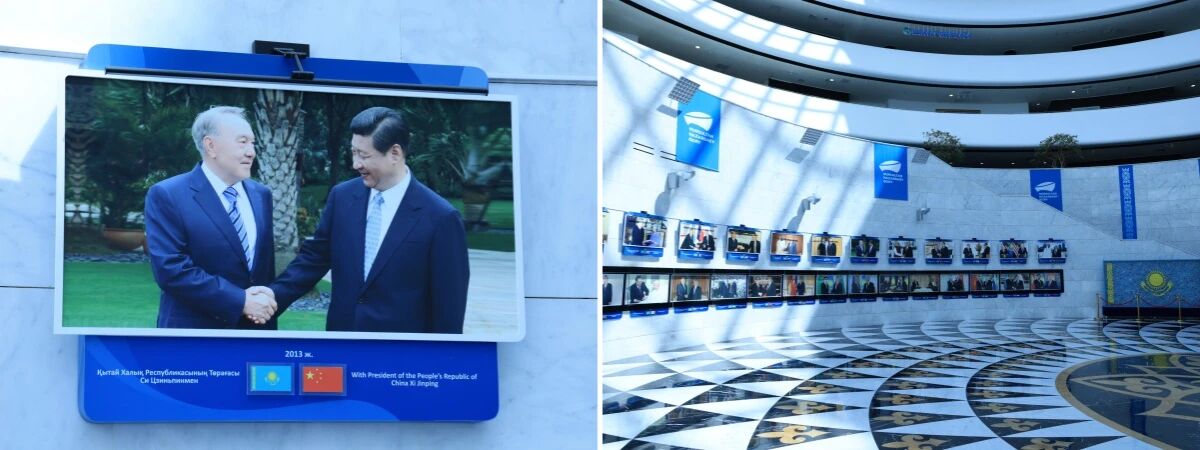
Photo: Nazarbayev Center
These field studies enabled students to develop a comprehensive understanding of Central Asia’s financial, innovation, and digital economy landscape while identifying emerging opportunities for bilateral cooperation between China and Kazakhstan.
Academic Excellence Meets Practice: Family Business Succession and Governance
The Astana module also featured the core course “From Family Business to Family Office: Succession and Governance,” taught by Professor Qian Peng, Professor of Practice, Department of Finance, Hong Kong University of Science and Technology (HKUST).
Delivered across two comprehensive sessions, the course explored family business strategy, succession planning, governance structures, family offices, family trusts, and governance best practices. Drawing upon leading theories and real-world cases from China, Singapore, Japan, and other markets, Professor Peng examined the underlying principles that enable family enterprises to achieve sustainable, multi-generational success.
She emphasized that family business management extends well beyond wealth preservation and ownership structures to encompass family relationships, shared values, governance mechanisms, leadership development, and long-term strategic planning.
Professor Peng also examined the practical challenges facing Chinese family businesses during generational succession and corporate transformation. She argued that succession, transformation, and strategic upgrading should be viewed as integrated long-term priorities rather than independent initiatives. The long-term vision of founders, the capabilities and aspirations of next-generation leaders, professional management systems, technological transformation, and the continuity of family values all play decisive roles in ensuring sustainable enterprise development.
The module concluded with case discussions and student reflections. Drawing upon their own business experiences, students exchanged perspectives on family governance, succession planning, intergenerational communication, family office development, long-term asset allocation, and entrepreneurial legacy, effectively integrating academic learning with real-world business practice.
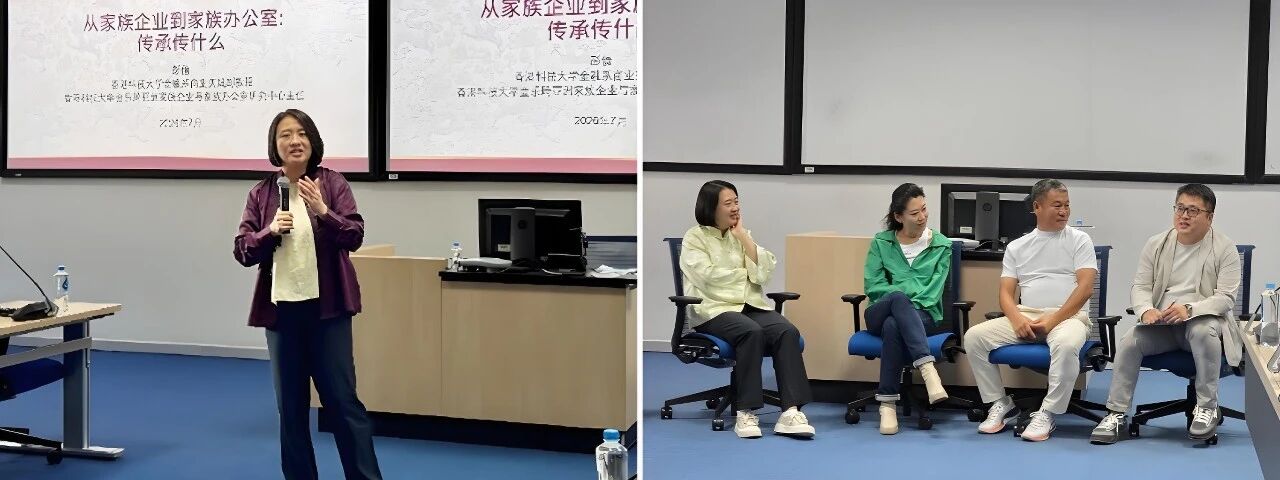
Photo: Professor Qian Peng (left); Case discussion (right)
As a signature overseas teaching component of the Tsinghua PBCSF BRI EMBA, the Astana Module embodies the Program’s commitment to integrating government, industry, academia, and research.
Anchored in the strategic heart of Central Asia and hosted at the birthplace of the Belt and Road Initiative, the module combined immersive field experiences with academic rigor to examine regional business environments, bilateral cooperation opportunities, sovereign investment, industrial development, corporate governance, and family business succession.
By providing students with a platform to understand, engage with, and invest in Central Asia, the Program equips executives to identify both the opportunities and challenges facing Chinese enterprises as they expand into Central Asia and connect with the broader Eurasian market.
The successful completion of the Astana Module not only deepened students’ understanding of Central Asia’s policy environment and industrial development, but also strengthened enduring networks between Chinese and Kazakh business leaders, contributing new momentum to the high-quality development of the Belt and Road Initiative through finance, innovation, and industrial collaboration.


